
Neurofeedback is called many things. It is referred to as EEG biofeedback, neuro-biofeedback, neurotherapy, and brain wave training. These terms are often used interchangeably. Neurofeedback training is effective for many conditions, such as head injuries, neuroses and anxieties, and a variety of conditions regulated by brain wave function.
Neurofeedback is a therapeutic intervention that presents the client with real-time feedback on brainwave activity, as measured by sensors on the scalp, and typically in the form of visual or audio rewards. The number of sensors determines if the clinician is doing “single channel” or “full cap” EEG. We do both. We also use a variety of neurofeedback methods and modalities.
When brain activity (amplitude or connectivity) changes in the direction desired by the customized neurofeedback protocol, a positive “reward” feedback is given to the individual. Most neurofeedback methods train brain waves to create conditioned self-regulation.
What Kind of Neurofeedback We Use
We use many forms of neurofeedback—there are many different schools of practice and types of software, hardware, and training to choose from. While we use many popular modalities of neurofeedback, such as Z-Score neurofeedback, single channel neurofeedback, alpha theta neurofeedback, amplitude training, and full cap training, we often use the system (hardware and software) developed by EEGer, which is synchronized neurofeedback and training. We have found that this modality is much faster than other forms of neurofeedback-only, since we can first demonstrate to the brain what we would like it to achieve, and then reward those results (neurofeedback-only models do not demonstrate to the brain how to behave, which makes for a much longer period for the brain to catch on).

UNDERSTANDING EEG
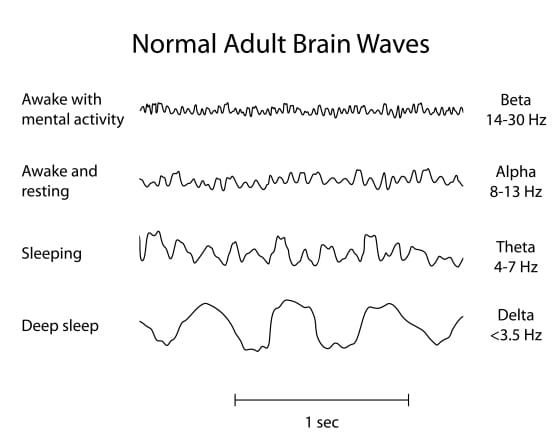
Brainwaves are categorized by frequency, which is “the power or speed of the electrical emissions, measured in oscillations per second, or hertz (hz). The brainwaves break down into Delta (1-4Hz), Theta (4-8Hz), Alpha (8-12Hz), SMR (12-15Hz), Beta (15-18Hz), High Beta (18-36Hz) and Gamma (40+ Hz).
Here is an article written by Dr. Thompson, Understanding the Patient’s Brain, published in the March/April edition of “The Therapist” magazine.

DELTA
Delta is the slowest brainwave, oscillating between 0-4 times-per-second (0-4 Hz). Humans’ raw EEGs show most brainwaves at any given time (kind of like how unhomogenized milk contains skim milk, 2%, and whole milk), but delta is the dominant brainwave during deep sleep in healthy adults. It is high amplitude (meaning the wave forms are big, relatively speaking). Babies in utero and in early infancy (between 3 months to 1 year) spend a great deal of time in delta — it is thought to be responsible for neurogenesis (the genesis of neural connections). Delta has been linked to the production of human growth hormone and serotonin. From a psychological perspective, delta has been linked to the unconscious, as well as the Jungian notion of the collective unconscious (Wise, 1995).
ALPHA
Alpha is an interesting brainwave — really, the king of brainwaves. Alpha is the most obvious brainwave to spot with the naked eye — it has high amplitude and is often rhythmic. It was the first discovered and classified by Berger, as well as the first brainwave used in experimental self-regulation (later called EEG Biofeedback) by University of Chicago professor Joe Kamiya in 1959. Alpha is the first conscious brainwave and the bridge that links the unconscious brainwaves of theta and delta to the active thinking brainwaves of beta and gamma. Alpha is 8-12 Hz, a relaxed and focused space, responsible for the state of flow, being in the zone, and creating. You are often in alpha when you are watching TV, driving your car, or doing any “mindless activity”. When we close our eyes, we signal to our body that we are in a position to relax and safely fall asleep. When we close our eyes, a normal response is an increase of 50% or more alpha in the back of the head.
The speed of your alpha brainwaves is your dominant or “peak” frequency. It is like the shutter speed of a camera. The faster your alpha peak frequency, the faster you are processing data and the more data you can, therefore, take in.
If Alpha brainwaves are high amplitude (big on they axis) the individual is often in a trace or an inattentive, daydreamy state. High amplitude alpha may mean that the individual uses a lot of THC, or may have attentional difficulties.
Alpha will attenuate, or “block,” when we become mentally occupied. The brain will then begin to generate “beta” waves, ranging from 15-36 Hz.


THETA
Theta brainwaves run at 4-8 oscillations per second (4-8 Hz), and are the dominant brainwave in REM sleep, dreams, and hypnosis. This is the subconscious and the borderland to consciousness. Theta is a powerful state for learning in an uncritical fashion. Hypnotherapists will take clients to the cusp of theta and alpha (read: unconscious and conscious) because humans are highly suggestible in this space. Jung felt that dreams were signs referencing complex psychological, emotional, and transcendental realities. Dreams access the storehouse of memories in the limbic system (the amygdala and the hippocampus); our individual dreams are often of a collective reservoir, containing ancient and primitive themes and narratives common to the human experience. When we are in theta, our subconscious offers us images that are symbolic of those repressed or otherwise inaccessible memories and information.
Seeing small delta and theta waves in the waking, eyes open EEG is normal. However, excessive or large (high amplitude) delta and theta waves often signify neurological or developmental problems.
BETA
Beta brainwaves cover a large spectrum of 12-15 Hz SMR, 15-18Hz and high Beta 18-36, and are the brain state of our normal waking consciousness. Beta encompasses all forms of action, thinking, and problem solving —from the mundane (making grocery lists), to the complex (computing mathematical equations). Beta is broken down into three categories (I, II, and III). Beta I is 12-15Hz and the calmest of all beta brainwaves, often coupled with stillness, presence, and low muscle tone. Beta II is 15-18 Hz and is at work when we undertake tasks involving detail, processing, and meaning comprehension. Beta III is 18-22 Hz and shows during states of high focus and engagement. This state can also be indicative of anxiety and stress.


GAMMA
If alpha is king, then gamma is guru. Gamma brainwaves are 30+ Hz, and have been associated with states of inspiration, hyperalertness, perception, and even enlightenment. Recent studies involving practiced meditators have shown gamma synchrony as a common finding in levels of heightened meditation and awareness. Gamma has been classically difficult to capture since it’s very fast and low in amplitude. It can be easily confused with the muscle artifact from scalp tension in EEG and is, for that reason, currently a difficult brainwave to train via neurotherapy.